
How to Search Civil Dockets
For a Dallas County docket search, open Search ARCourts, the free statewide public case-information portal. Got a case number? Choose Cases. Choose Participants to look up a Dallas person or organization. In the detailed search, select Dallas County. If the results still mix courts, use Court Location to narrow them. Exact organization wording works best. When the recorded name is uncertain, the official training suggests typing one or two key Dallas organization words into the Last Name field instead. Jurisdiction comes next, before any result counts as complete. Dallas County Circuit Court handles general civil litigation. Dallas County District Court handles specified contract, personal-property damage, and recovery-of-property matters through $25,000, with small claims through $5,000. Because District participation in Search ARCourts is conditional, a missing lower-court case may require a call to the Fordyce or Sparkman department.
- Choose Cases or Participants for the Dallas search.
- Enter the known Dallas number, party name, or organization words.
- Select Dallas County and, if useful, the Dallas court location.
- Open the Dallas County Case Summary, Participants, Case Events, and Docket Entries.
- Contact the Dallas filing clerk for an unlinked document, current setting, or certified copy.
Dallas County Civil Docket Limits
The amount and type of claim decide which Dallas County civil docket holds a case. Circuit Court keeps general Dallas civil jurisdiction. Under the Arkansas Judiciary’s District Court description, District Court takes contract claims, personal-property damage, and recovery of personal property through $25,000. Its small-claims division stops at $5,000. Treat both figures as jurisdiction limits. They are not filing fees and not predictions about any Dallas case.
| Civil track | Scope | Record keeper |
|---|---|---|
| Dallas Circuit civil | Dallas general-jurisdiction civil litigation | Dallas County Circuit Clerk |
| Dallas District civil | Specified Dallas civil claims through $25,000 | Fordyce or Sparkman District clerk |
| Dallas small claims | Dallas claims through $5,000 | Fordyce or Sparkman District clerk |
Trust the Dallas court and location printed on the Case Summary or the filed papers. The prominence of the Dallas courthouse does not make the Circuit Clerk custodian of every limited civil file.
What a Civil Docket Shows
A docket entry never stands alone; it sits inside a larger Dallas case display. Case Summary identifies the case and its status. Participants lists the public roles, such as plaintiff and defendant or petitioner and respondent. Case Events carries the settings. Docket Entries supplies the filing chronology. Document links appear whenever a public image is available.
| Case number | County or city prefix, case-type prefix, two-digit year, and sequence. Use the exact format from official papers. |
|---|---|
| Parties | Names and recorded roles; a matching name alone does not establish identity. |
| Docket Entries | Filing time, description, docket detail, associated name, and document link or “None.” |
| Case Events | Date, time, event, room, location, judge, and event status where public. |
| Outcome | Order, judgment, dismissal, post-judgment activity, or appeal entries as recorded. |
Remember that the portal result is not the official Dallas court record. A clerk-certified copy, not a screen print, is the formal reproduction of a filed judgment or order.
Dallas County Civil Docket Sequence
Read a Dallas civil docket in chronological order and the story assembles itself. The complaint or petition starts the action. Entries about service or summons show that formal notice steps were recorded. An answer responds to the claim. Motions ask the court to rule; orders state the court’s direction. A notice of setting paired with a Case Event marks the hearing stage. A judgment records an enforceable determination. Collection, writ, relief, or appeal activity may still follow it.
- Complaint or petition
- The pleading that starts a civil matter.
- Motion
- A party’s request for a court ruling.
- Order
- A written direction or decision from the court.
- Judgment
- A final or enforceable determination.
- Appeal
- A request for review that ordinarily creates a separate appellate docket.
Treat short entry labels as an index, nothing more. The filed complaint, motion, order, or judgment holds the allegations, requested relief, and legal reasoning that a terse row cannot supply.
Types of Civil Cases on the Docket
Dallas County Circuit Court sorts its work through subject-matter divisions. These divisions come from Arkansas’s post-Amendment 80 structure. Civil, probate, domestic relations, juvenile, and criminal are divisions of Circuit Court. They are not interchangeable labels for one result set. General civil litigation belongs to the civil division. Probate and domestic relations filings need their own case-type review.
- Dallas County general civil contract and tort litigation in Circuit Court
- Property-related civil claims within the proper court’s jurisdiction
- District civil contract and personal-property matters within the stated limit
- District small claims within the $5,000 limit
- Probate and domestic-relations matters in their separate Circuit divisions
Confidentiality differs by division and document in Dallas records. Adoption, juvenile, protected family material, and sealed filings should never be assumed public. The Circuit Clerk’s custody of the overall court file does not change that.
Dallas County Civil Docket Filters
Organization names trip up more Dallas County civil docket searches than any other field. Search ARCourts works best with the exact name the clerk recorded. Is that wording unknown? Enter one or two key organization words in the participant search. Then set County Name to Dallas. Add Court Location only if you must. A location choice that is too narrow can hide a relevant record. The record may have been filed elsewhere in the county’s court structure.
| Portal field | Use | Important limit |
|---|---|---|
| Search by | Cases or Participants | Choose the path that matches known information |
| Organization words | Participant lookup | Exact recorded wording works best |
| County Name | Select Dallas | Do not assume a broad search is county-specific |
| Court Location | Narrow a broad result set | District Court coverage remains conditional |
| Date range | Limit filing period | A filing date is not a hearing date |
Result rows sort and filter, with display sizes of 25, 50, or 100. Check party roles in the opened case. The name list alone is not enough to draw a conclusion.
Settings and Hearings on Civil Dockets
Search ARCourts splits these into separate blocks. Dallas County Case Events and Dallas County Docket Entries each get their own. The event block lists the scheduled date and time, event, room, location, judge, and status. Docket Entries can carry the notice or order behind a setting. It may have created, reset, continued, or cancelled it. Read both. Pay closest attention to entries filed after an earlier date.
A reset never dismisses a Dallas County civil case. The old event can linger as history while a newer one controls what happens next. Line up the latest future setting against later orders and notices. Then call the Dallas County Circuit Clerk or the right District department as the hearing date closes in. Filed instructions and direct court communication control, since Search ARCourts is not legal notice.
Note: A filing date, a service date, and a hearing date are different events. None can stand in for another.
Dallas County Civil Docket Index
A Dallas County docket row records that an act or filing happened. It does not reproduce the pleading itself. Labels like complaint, motion, order, or judgment point you toward the right item. The document holds the actual request, facts, findings, and terms. Some public entries include links, and some show “None.”
“None” is not proof that no paper exists. Contexte can link into a separate approved document-management system. Remote image coverage varies by court and filing. Write down the case number, entry date, and exact description. Then ask the proper clerk for the filed item. Safari users should also allow pop-ups before concluding a document link failed.
Practical rule: use the Dallas County civil docket to identify the filing, then use the document or clerk-certified copy to read its full terms.
Dallas County Civil Docket Clerks
Dori Keeton serves as Dallas County Circuit Clerk, and her office at Third and Oak Streets in Fordyce keeps Circuit civil, probate, domestic-relations, and juvenile records. Call 870-352-2307 for that office. District civil and small-claims files stay with the Fordyce clerk at 870-352-2332 or the Sparkman clerk at 870-678-2255.
Circuit Clerk
Third and Oak Streets
Fordyce, Arkansas 71742
870-352-2307
General civil and other Circuit divisions.
Fordyce District Clerk
PO Box 672
Fordyce, Arkansas 71742
870-352-2332
Fordyce limited civil and small claims.
Sparkman District Clerk
110 East Main
Sparkman, Arkansas 71763
870-678-2255
Sparkman limited civil and small claims.
Dallas County publishes no local copy fees, copy-order form, turnaround time, or mail procedure. Ask the clerk for current terms before sending money or making a trip.
Dallas County Civil Docket Filing
Arkansas eFlex is the electronic filing engine. Contexte is the legacy case-management system feeding Search ARCourts. The two play different roles. A Dallas County filer submits through eFlex once authorized and trained, while the public reads eligible Dallas County case information through Search ARCourts. The eFlex registration charge is not a fee to run a public docket search. The official Arkansas e-filing outage notice spells out filing duties under Administrative Order 21 during a system outage.
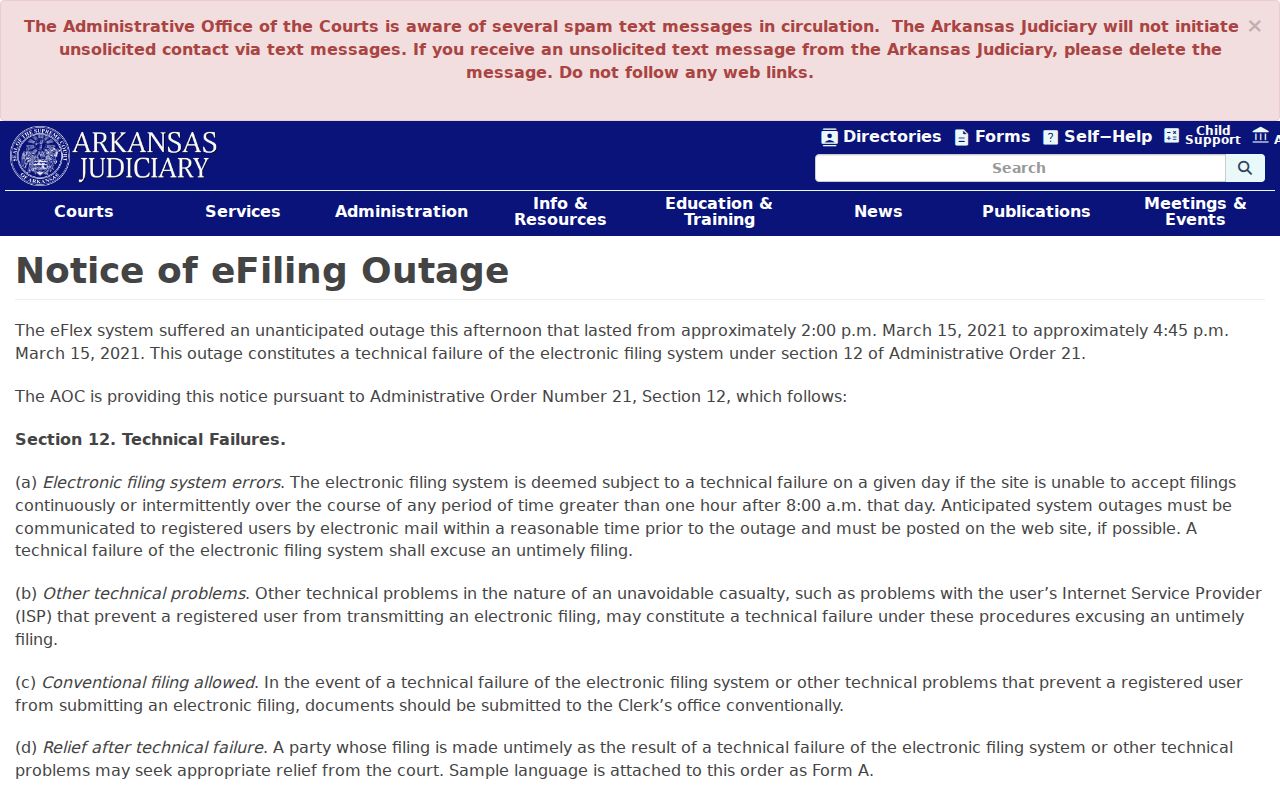
That notice separates a filing interruption from public case access. It does not prove a local Dallas outage, and it does not replace confirming a filed item with the clerk.
Dallas County Civil Docket Copies
Gather the court, case number, and case style. Note the filing date if known and the exact docket description. Say whether you need a plain or certified copy. A certified judgment is authenticated by the filing clerk. A portal printout is no substitute. When an online entry reads “None,” give staff the entry date and label so they can pull the official file.
Dallas County posts no local fee schedule. Ask about the total and payment method. Ask about delivery, identification, and any archive retrieval cost before you send money. A published fax number alone does not mean fax copy orders are accepted. A hearing or trial transcript is a separate product. It comes from the court reporter, not the clerk’s docket counter.
Dallas County Civil Docket Data
A request for compiled civil, probate, or domestic information moves along a different route than a request for a single judgment. One state office administers the forms and the safeguards, working under Administrative Order 19. Expect added requirements whenever identifiable or excluded information is involved. Treat this route as its own process. It is not a way around a sealed record. It does not replace the filing clerk for ordinary copies. The compiled-information request form shows what that office collects. It lists requester details and the scope of the information sought. It also asks whether naming specific people is essential to the request.
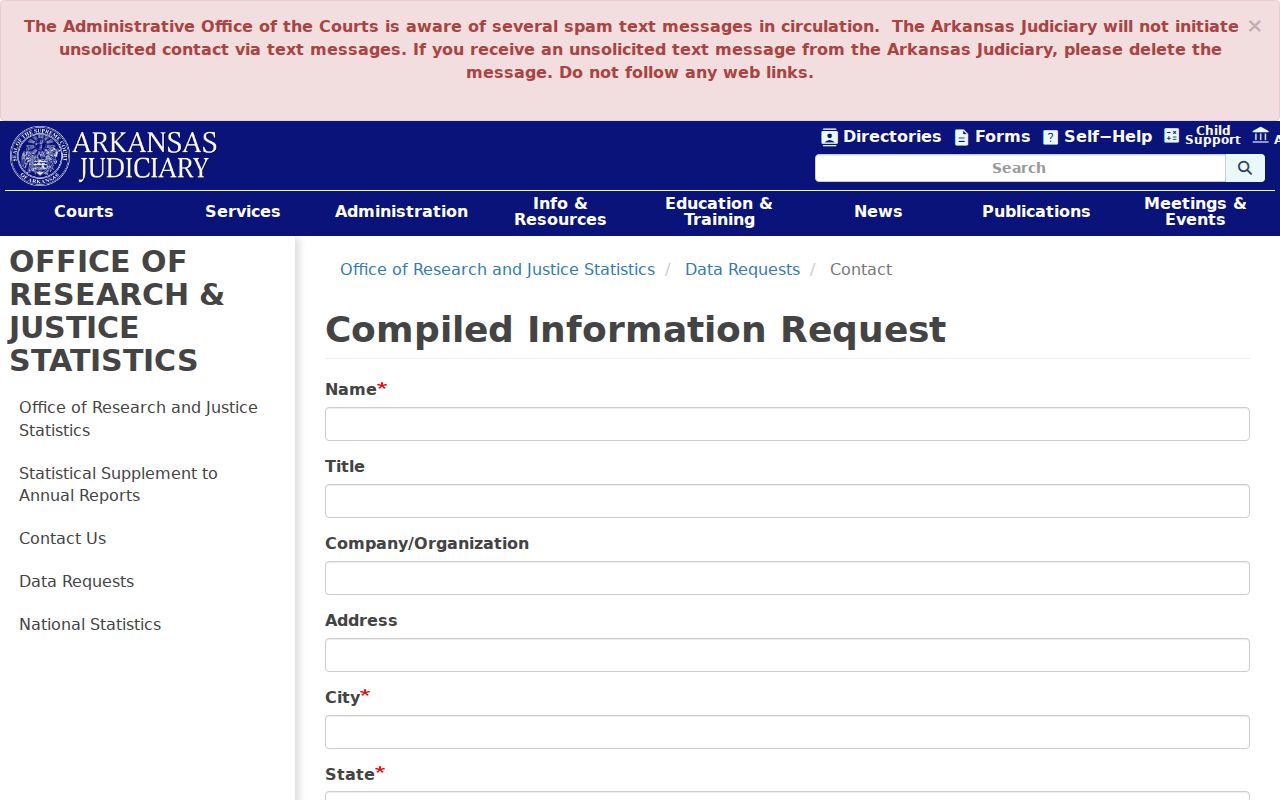
The form makes clear this is a structured data request, not a document order. Tracking one civil case? Use Search ARCourts and the correct Dallas County clerk instead.
Dallas County Civil Docket Appeals
A Dallas County appeal adds entries to the trial-court register. Appellate review runs on its own docket. District Court appeals move to Circuit Court under Arkansas procedure. Circuit civil appeals ordinarily go to the Arkansas Court of Appeals. Some categories go instead to the Arkansas Supreme Court under Supreme Court Rule 1-2.
Follow the notice of appeal and later trial-court entries. Then switch to the appellate system for the new appellate record. Trace transfers, referrals, and consolidation through the newest entries. Do not rely on the caption. For a broader walkthrough by name or case number, use the Dallas County case search.
Note: A notice of appeal on the civil docket marks a step. The reviewing court keeps its own case register.
Public Access to Civil Dockets
Dallas County residents who want to read a civil docket rely on Arkansas Administrative Order 19. It is the governing authority for public court records. Access is not unlimited. Federal law, Arkansas statutes, court rules, court orders, and confidential categories all place limits on what a Dallas County docket search can reveal. Redaction rules add another layer: Administrative Order 19.1 and Arkansas Rule of Civil Procedure 5(c)(2) control how sensitive details get removed. A public version of a Dallas County civil filing may look thin, with protected data omitted, while the unredacted version stays under seal. That gap is deliberate, not an error.
Access boundaries:
Public Case Summary and Docket Entries may omit confidential identifiers and sealed material.
A redaction notation can mark partial removal; a sealed item may have only a placeholder or no public link.
Arkansas FOIA does not override court-record restrictions imposed by statute, rule, or court order.
A Dallas County civil docket that will not come up can be missing for many reasons. The name may be spelled wrong. The court may be wrong. District coverage can be conditional, or the file may be old, confidential, or sealed. Ask the filing clerk instead of guessing which one applies. Paying a fee or filing a general records request will not unlock restricted material.